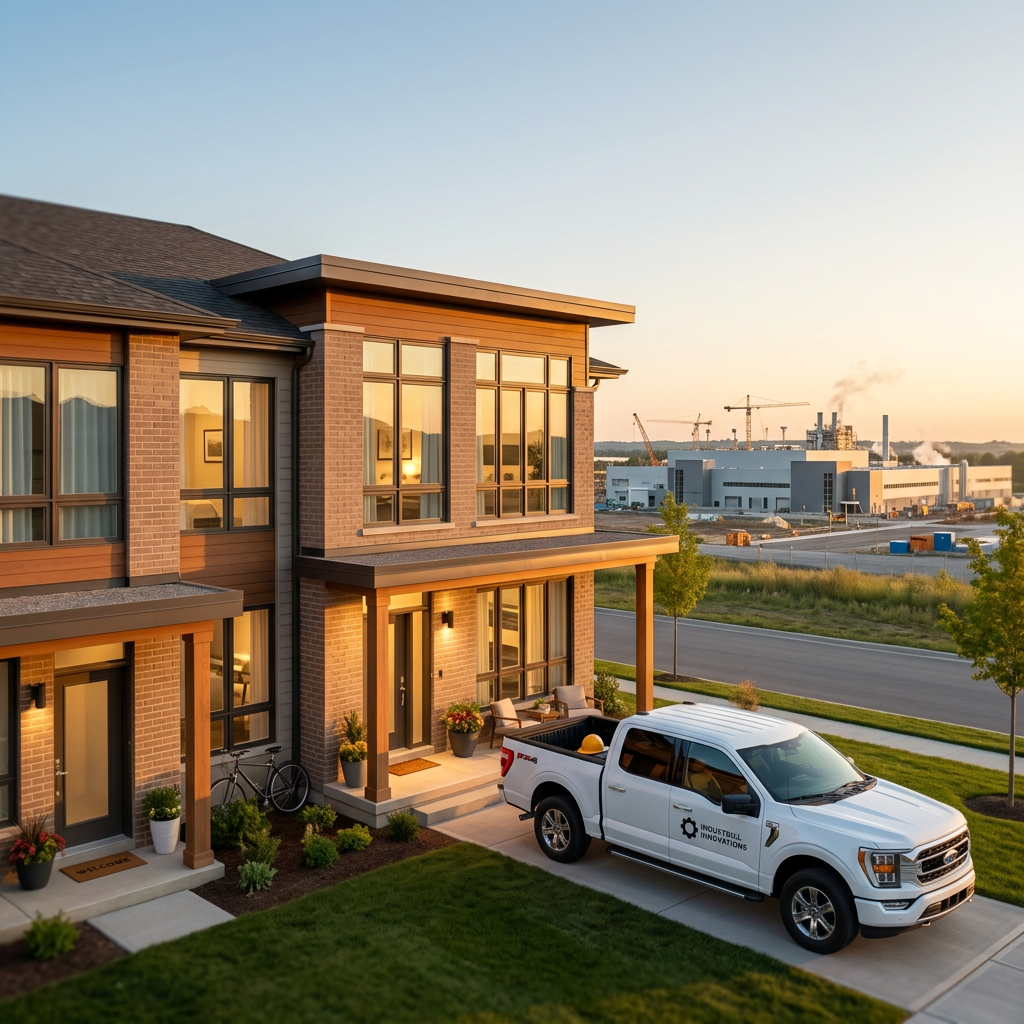
If you are trying to house a crew near a new plant, the national numbers will mislead you. In its June 2026 report the Bureau of Labor Statistics listed manufacturing among the industries where employment showed little or no change over the month. Read only that line and you would conclude nothing is happening.
Now drive to a county where a large site is going up. Every furnished unit within thirty minutes is already spoken for. Both things are true at the same time, and the gap between them is the whole problem.
The National Data Hides the Part That Affects You
National employment moves slowly because it averages an entire country. A single project pulls a few hundred specialized workers into one county for eighteen months. That barely registers in a national payroll figure, and it can consume the whole short stay housing supply of a small market.
The workweek tells you more than the headline. BLS put the manufacturing average workweek at 40.3 hours in June 2026, with overtime at 3.2 hours. Long hours and steady overtime describe crews already deep in the work rather than a hiring wave building. For housing, that means demand is concentrated, sustained, and tied to a schedule you can actually plan against.
Costs Are Cooling Nationally and Still Biting Locally
The Bureau of Labor Statistics reported the shelter index up 3.3 percent over the twelve months ending June 2026, with a monthly increase of just 0.1 percent, the smallest one month change for that index since January 2021. Nationally, the pressure is easing.
That figure will not describe your site. A county absorbing a large construction crew becomes its own market for the length of the project, and the binding constraint there is supply, not the national trend. Budget from local reality and treat the national number as background rather than a forecast.
Two Waves, Two Different Housing Problems
- Construction and commissioning. Trades, project managers, safety and environmental staff, specialized engineers. Large headcount, shorter individual stays, constant rotation, and start dates that move. This wave needs flexibility far more than it needs polish.
- Operations ramp up. Permanent technicians and supervisors arriving before they have leased or bought anything local. Smaller headcount, much longer stays, families often involved. This wave needs quality and a longer runway.
Housing both waves the same way is the mistake we see most often. A block of units booked for rotating trades is wrong for a technician relocating a family, and a comfortable long lease is wrong for a crew that cycles every six weeks.
What to Settle Before the Crew Arrives
- A headcount band per phase, not a single number. Schedules slip and crews resize.
- Rotation rules. Who holds a unit when one worker cycles out and the next cycles in, and who pays for the gap.
- Per diem alignment if any of the work is federally funded. The rate ceiling shapes what you can offer.
- One invoice per phase. Reconciling dozens of individual bookings is where project admin time disappears.
- An extension path agreed up front. Commissioning almost always runs longer than the plan.
For crew housing specifically, our construction workforce housing page covers how these placements are structured. If the site sits near a mid sized market, furnished rentals in Columbus shows the kind of inventory to expect outside the major metros.
Tell us the site, the phase, and the headcount band, and we will tell you honestly what we can cover. Start on the housing request page or call 1-855-552-9155.
Sources & References
- The Employment Situation, June 2026 (Bureau of Labor Statistics, Jul 2026)
- Consumer Price Index, June 2026 (Bureau of Labor Statistics, Jul 2026)
Related Housing Solutions